A community becomes what it tolerates: moderation, consent and safety on dating apps
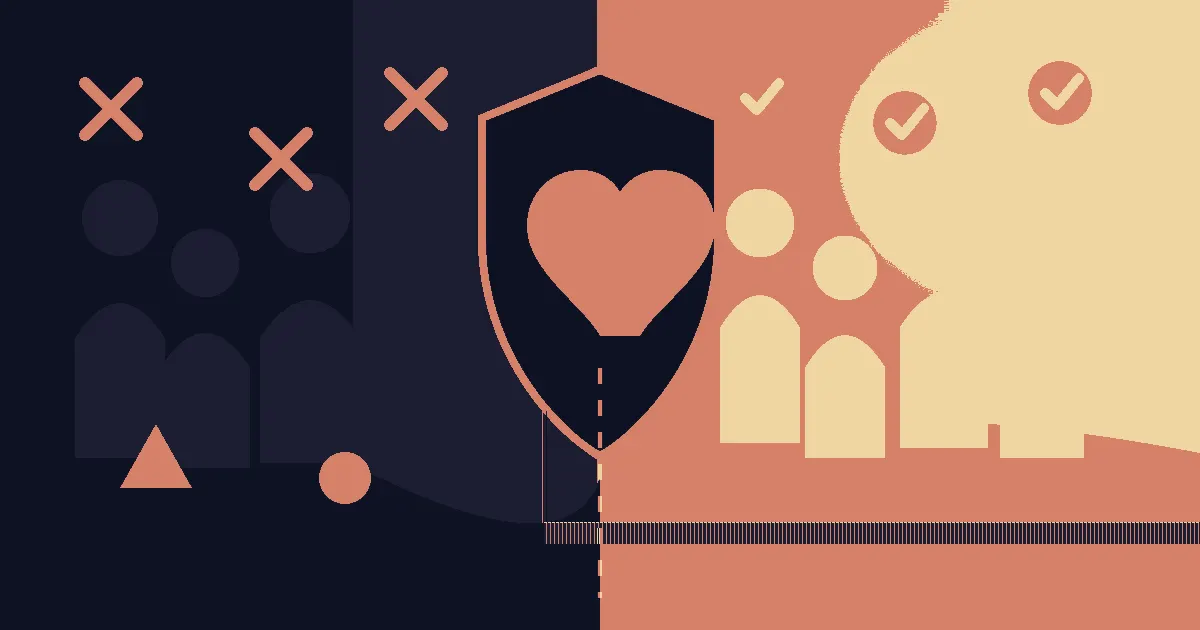
A dating app is never just an app. At first there is code, profiles, a messaging system and a few users. Then something invisible appears: a culture.
Every behaviour that is accepted helps shape it. So does every report that is handled — or ignored. Every ban, every rule, every person who decides to stay and every person who eventually leaves contributes to the social environment.
That is why safety cannot be reduced to a “Report” button.
A community gradually becomes what it tolerates.
This is one of the most important lessons we draw both from building Mad2Moi and from years of observing online communities through Madintouch.
How harmful behaviour can contaminate a community
Imagine a new platform with 1,000 members. Ten of them repeatedly harass other users.
Scenario A: rules are visible and enforced
Reports are reviewed quickly. Prohibited behaviour is sanctioned. Repeat offenders leave. Other users see that the rules have real consequences. The collective norm becomes: “that behaviour does not work here.”
Scenario B: rules exist but have little effect
The same reports remain unanswered. People targeted by abuse understand that they are on their own. Some leave. Aggressive users remain and meet others who behave in the same way.
The proportions gradually change. Then the reputation changes too. The platform can end up attracting exactly the people who are looking for that kind of environment.
This is a form of community selection: rules → tolerated behaviour → members who stay → reputation → new members → new norm.
The real question is not only who joins, but who stays
A well-moderated community cannot prevent every bad actor from appearing. No serious public platform can promise that.
What it can do is make it clear, quickly and consistently, what is accepted, what is prohibited, what should be reported and what happens when a boundary is crossed.
That consistency gradually creates trust.
Why women are often central to this equation
The experience of a dating app can vary dramatically depending on profile and context. Some women face immediate sexual requests, unsolicited intimate images, repeated contact after a refusal, insults after not replying, stalking, extortion attempts or demands for personal information.
When an environment becomes exhausting or aggressive, people who already receive many approaches have little reason to stay.
This can trigger a negative loop: women leave, the gender balance deteriorates, men receive fewer replies, some increase the volume or intensity of their messages, and the remaining women receive even more unwanted attention.
Women’s safety is therefore not only a moral issue. It is also an important condition for the health and balance of a dating community.

Consent is the most important word in modern dating
Consent is sometimes caricatured as something that destroys spontaneity. It does not.
Consent simply means wanting what is happening and being able to change your mind.
Someone can consent to a date but not to sex. Consent to sex but not to filming. Consent to a photo but not to its publication. Consent today and refuse tomorrow.
The same principle applies to conventional dating, libertinism, BDSM, polyamory and casual encounters.
Sexual freedom and rules are not opposites
A free community is not a community without rules. Often the opposite is true.
The more intimate exploration a community allows, the clearer its boundaries need to be. Genuine sexual freedom requires adults, consent, privacy, the ability to say no, the ability to withdraw consent and the ability to leave a situation.
Libertinism without consent is not libertinism. BDSM without consent is not BDSM. Sharing an intimate image without permission is not sexual freedom.
Platforms are never neutral
Interfaces shape behaviour. Unlimited messaging or message limits shape behaviour. Showing online status shapes behaviour. Making it easy to return after a ban shapes behaviour. Verification options shape behaviour. Easy blocking shapes behaviour.
Even the design of a button can influence a community.
A digital platform is therefore, in part, social architecture.
Coco, Wyylde and the same questions in different forms
For years Madintouch has investigated online communities and dating platforms. Its Coco file was already archived in September 2021, long before the service was shut down. In 2026, the opening of an investigation involving Wyylde once again placed moderation, consent and platform responsibility at the centre of public debate.
Wyylde and Coco are not the same platform and their legal situations should not be equated point by point.
But both cases underline the same principle: community growth must be matched by equivalent growth in governance, safety tools and moderation procedures.
For the full sourced investigation, read: Wyylde, Coco and platform responsibility on Madintouch.
We will not promise “zero risk”
This may be one of the most important promises not to make.
No open public app can guarantee zero fake profiles, zero scammers, zero aggressive behaviour or zero malicious users.
Such a claim would be unrealistic.
Our responsibility is different: reduce risks, make reporting easy and act when prohibited behaviour is identified. That is less spectacular than a slogan, but far more credible.
Reporting should be treated as a core feature
Many apps hide their reporting tools behind several menus. That is a mistake.
A good reporting flow should help people understand why they are reporting, what happens next, whether they should also block the user, whether evidence can be preserved and when contacting authorities may be appropriate.
Reporting is not a secondary feature. In some situations it is the most important feature in the entire app.
Blocking should work immediately
When someone blocks another user, they should not have to negotiate that decision.
The implicit message should be simple: “no” is a complete sentence.
The blocked user does not need to understand. They do not need to be convinced. They do not need an immediate second chance.
Automation and humans: why both are needed
At small scale a team can review a large proportion of situations manually. As a platform grows, that model becomes impossible to sustain alone.
Automated tools can help detect spam, repeated messaging patterns, suspicious activity, problematic content and signals associated with certain scams.
But machines do not always understand context.
An automated signal should therefore never be confused with an automatic judgement. Complex situations still need human review.
Mad2Moi currently combines technical safety tools, blocking, reporting and human review of escalated cases. The goal is not to pretend risk disappears, but to reduce the time during which harmful behaviour can remain unanswered.
Verification helps, but it is not magic
Profile verification can reduce some impersonation risks and improve trust between members.
It does not prove that a person will behave respectfully in a conversation or on a date.
Verification is one safeguard among several, not an absolute guarantee.
Real-life meetings change the responsibility again
Mad2Moi is no longer limited to online interaction. The platform also offers outings and real-world events.
That creates a major opportunity: an app can become a real community.
But moving from screen to real life also requires more vigilance: venue safety, organiser presence, behavioural rules, alcohol, respect for refusal, privacy of contact details and procedures for handling incidents reported after an event.
See upcoming Mad2Moi outings
A smaller community has one major advantage
A large platform has more resources. A smaller community has something else: proximity.
Members can surface problems. The team can recognise recurring patterns. Rules can evolve quickly. Culture can be built before millions of people impose it on the platform.
That work needs to happen now, not afterwards.
What Mad2Moi wants to defend
We want a community where people can look for love, friendship, outings, open relationships, libertinism, polyamory, conventional relationships or simply new people to meet.
But that diversity only works when there is one common rule: respect what the other person wants — and what they do not want.
What other platforms can teach us
Looking at problems encountered by other services should not be used to say, “look how much better we are.” That would be arrogant.
The more useful lesson is: “this could happen to us too if we stop paying attention.”
A platform grows. The founding team becomes too small. Message volume rises. Reports rise. Usage changes. Founders no longer know the community personally. Governance therefore needs to grow as fast as the audience.
A community is never finished
It is recreated every day. With every new member, every message, every sanction and every failure to sanction.
Building Mad2Moi is therefore not only about features. It is about repeatedly answering one question: what kind of place do we want to be tomorrow?
Our answer is simple: free, but not without boundaries; open, but not to predatory behaviour; sex-positive, but based on consent; human, above all.
Essential safety tips before meeting someone
Even with good moderation, personal caution remains useful. Do not immediately share your home address. Never send money to someone you met online. Prefer a public place for a first meeting. Tell someone you trust. Keep messages if a situation worries you. Block and report when a boundary is crossed.
FAQ
Can a dating app guarantee zero fake profiles?
No. It can reduce the risk through verification, detection, community reporting and human review, but an absolute guarantee would not be credible.
What should I do if someone keeps contacting me after I refuse?
Block the account and report the behaviour when appropriate. You do not owe anyone a continuation of the conversation.
Does libertinism mean fewer rules?
No. The more intimate the context, the more important clear, informed and revocable consent becomes.
Why does moderation shape a whole community?
Because what a platform tolerates influences who stays, who leaves and which new users are attracted by the reputation that emerges.
Why does Mad2Moi talk so much about outings and community?
Because a dating platform can become more useful when it also helps members build real social connections: friendships, outings, events and local communities.
Conclusion
Platforms love to talk about algorithms, features, growth and registered users. But the most important metric may be simpler: the people your community gives a reason to stay.
An app can attract huge numbers and gradually become unpleasant to use. Another can remain smaller and build a real culture. Over time, that culture creates trust — and trust creates encounters.
A community becomes what it tolerates. It is up to us to choose what Mad2Moi becomes.
What the community is saying