Dating as a free thinker: finding people who don't ask you to keep quiet

Tired of justifying what you think? Looking for love or friendship with people who won’t ask you to keep quiet about it? You’re in the right place.
Why people who ask questions end up isolated
Let’s be honest: something broke in ordinary conversation after 2020. You used to be able to argue politics over a drink, disagree cheerfully, and finish the evening laughing. Now, raising certain subjects — health, individual freedoms, how a crisis was handled — makes half the table tense up and the other half slide their chair away so as not to be associated with you.
And in the middle of that, there’s you: someone who doesn’t accept what’s put in front of them without asking a question, who reads, compares and connects things — and who gets labelled the moment they open their mouth.
The automatic-verdict reflex
It has become almost comic:
- You mention geopolitics? 👉 Labelled.
- You ask a question about the pharmaceutical industry? 👉 Labelled.
- You find the coverage short on nuance? 👉 Labelled.
- You simply claim your freedom to choose? 👉 Labelled.
The label has stopped meaning anything. It has become a reflex for closing a conversation rather than having it. And that vagueness is probably what isolates people most.
The distinction nobody wants to make: sceptical is not credulous
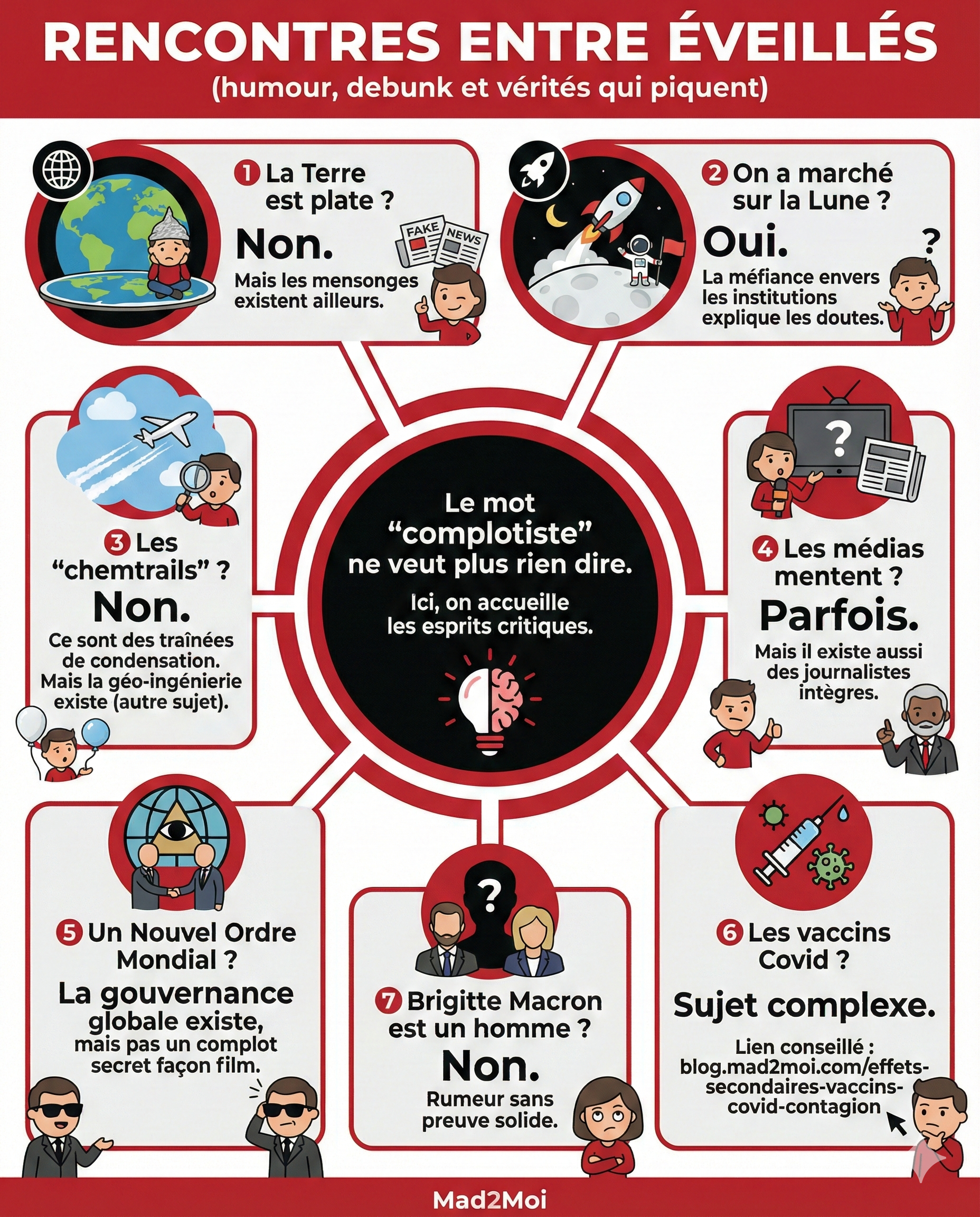
The two get deliberately confused, and they are opposites. Credulity accepts a claim because of who is making it. Scepticism asks what the claim rests on — and that includes the claims that flatter what you already believe. Someone who swallows every alternative explanation isn’t being critical; they’ve just changed which authority they trust.
The moment trust broke
During the health crisis something simple happened: trust evaporated.
A reasonable «no» was taken as a personal attack. «I’d just like to understand» was treated as heresy.
A lot of couples found themselves split for the first time in their lives. Some didn’t survive it. It’s a quiet kind of damage that nobody talks about, partly because both sides felt they were the reasonable one.
Why mainstream apps stopped working for you
If you’ve tried the big dating apps lately, you know the pattern. The moment certain subjects come up, the conversation closes.
You end up cast as odd or difficult. In reality you are someone who thinks — who refuses to flatten a complicated subject into a slogan. That unsettles people who would rather not look at it.
It’s worth being fair here too: the reflex runs both ways. Deciding in advance that anyone who disagrees with you is asleep closes exactly the same door, just from the other side.
Mad2Moi: room to say what you think
If you’ve read this far, you’ve noticed that neutrality has largely left the mainstream apps. You’re looking for somewhere you can be yourself without managing every sentence.
Elsewhere: you’re judged, you keep your head down, you avoid whole subjects so as not to scare off a date.
Here: you talk, you argue, you laugh, and sometimes you fall in love. You don’t have to agree on everything — you have to be honest. That’s the whole rule.
You don’t have to be in love to stop being alone
Many people lost childhood friendships over these divisions. Rebuilding a social circle matters more for your health than most people admit, and it is slower than finding a partner. On Mad2Moi you can look for friends as easily as for a relationship — how to make new friends covers the rest.
Where these people actually are, offline
Digital is convenient; real life is better. People who think for themselves aren’t always easy to spot day to day, but they’re not rare. You’ll find them in permaculture and food-autonomy networks, in alternative schooling and home education circles, around holistic and alternative care — and, in numbers, on Mad2Moi.

What the community is saying