Chat Control in 2026: who is really scanning your messages — and how to protect your intimacy
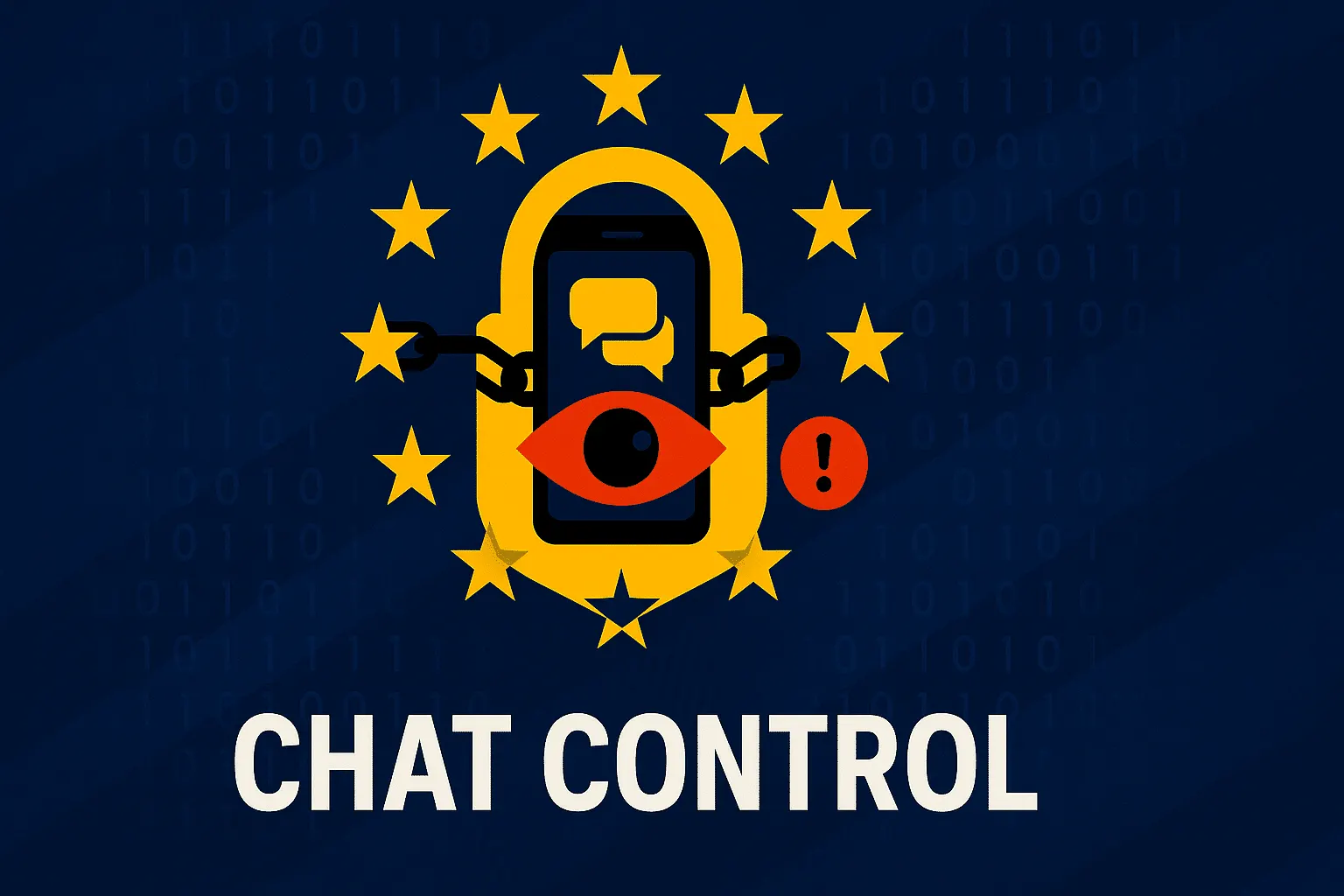
Updated August 2026 — after the European Parliament vote of 9 July, ahead of the 29 September trilogue.
The short answer, no panic and no denial: no, “Chat Control” has not been passed. The permanent law has been deadlocked through five rounds of Brussels negotiations. But on 9 July 2026, the European Parliament failed to bury its “temporary” little sister: voluntary scanning of your messages by Gmail, Messenger, Instagram, Snapchat or Xbox is back until April 2028. Your end-to-end encrypted conversations (WhatsApp, Signal) are not being scanned today. Your unencrypted messages can be — legally.
Orwell warned us that some things need only be named to be seen. So let’s name them: here is exactly where things stand, who is pushing what, and what you can do — no bunker, no paranoia.
What exactly is Chat Control?
The nickname covers two different texts that everyone mixes up — and that confusion suits a lot of people just fine.
| Chat Control “1.0” | Chat Control “2.0” (CSAR) | |
|---|---|---|
| Nature | Temporary ePrivacy derogation | Permanent regulation |
| Status August 2026 | In force until 3 April 2028 | Deadlocked — 5 trilogues, no deal |
| Scanning | Voluntary, by platforms | Under negotiation: mass voluntary (Council) vs suspect-targeted (Parliament) |
| E2E encryption | Not affected | Protection agreed in the negotiation |
| Services concerned | Gmail, Messenger, Instagram, Skype, Snapchat, iCloud Mail, Xbox | Potentially all |
The stated goal of both texts is fighting child abuse — a goal no sane person disputes. The battle is about the method: scan everyone hoping to catch someone, or target suspects with a judge’s warrant. The whole Brussels fight fits in that one sentence.
What changed in 2026?
The year has been a legislative ping-pong match, and you need the score to avoid being played by sensational headlines — in either direction.
- 26 March 2026: Parliament rejects extending voluntary scanning by 307 votes to 306. One vote.
- 3 April 2026: the derogation expires. Voluntary scans stop for the first time since 2021.
- 26 June 2026: the Council relaunches the text as a formally “new” proposal — the procedural workaround is barely disguised.
- 9 July 2026: Parliament fails to block it (314 votes, 361 were needed). Voluntary scanning is back, until 3 April 2028.
- Next step: the sixth trilogue on 29 September 2026, under the Irish presidency — historically pro-scanning.
Meanwhile the permanent law stays stuck on one hard point: the Council wants to make “voluntary” mass detection permanent, Parliament demands suspect-targeted measures with judicial warrants. Two visions of the world, one negotiating table.
Who is actually reading your messages today?
What gets scanned in August 2026: messaging and services not end-to-end encrypted whose operator chose to scan — Gmail, Messenger and Instagram (Meta scans massively), Skype, Snapchat, iCloud Mail, Xbox Live. It’s legal, it’s “voluntary”, and you agreed to it somewhere in terms of service nobody reads.
What is not scanned: end-to-end encrypted conversations. WhatsApp, Signal, Threema — their content is technically unreadable for the operator and for Brussels alike. Signal has been blunt about it: it would rather leave the European market than install a backdoor. Encryption protection has been agreed in the permanent-law negotiations — that is THE privacy movement’s win so far, and it stays fragile until something is signed.
What could flip: if the Council pushes its version through in September, “voluntary” scanning becomes the ecosystem’s permanent norm. Germany anchors the blocking minority alongside Poland, Austria, the Netherlands, Finland, Estonia, Slovenia, Luxembourg and Czechia. If you’re reading this from Ireland or Spain — your governments are on the pro-scanning side of the table. Worth remembering next time someone mentions digital sovereignty.
Why does this matter on a dating platform, specifically?
Because we’re not talking about your work emails. We’re talking about your intimate life.
On a dating platform, private messages hold the most personal things you own: your desires, your photos, your fantasies, your charming 1 a.m. typos. A detection algorithm that gets it wrong — and they do get it wrong, false-positive rates on intimate images between consenting adults are documented — means your private photo in a review queue, examined by strangers, because a puritan AI misread an adult body.
Jules and I ran the real-world test a few months ago: the same private photos, sent through three mainstream messengers and through Mad2Moi. No incident anywhere — but on two of the three messengers, there was no way to know whether and by what they had been analysed. That is exactly the problem: you don’t know. Intimacy does not survive uncertainty.
How Mad2Moi protects your conversations — honestly
No fear marketing here. The contractual and technical reality, nothing else.
What we do:
- No AI scanning of your private conversations. The European derogation is voluntary: nothing obliges us to scan your messages, so we don’t. Full stop.
- Data minimisation (GDPR): we collect only what makes the service work, hosted in the European Union.
- Your intimacy is not our product: no data resale, no ad profiling of your conversations. Our model is the subscription — you are the customer, not the merchandise.
- Opt-in private gallery: your intimate photos are visible only to whom you explicitly authorise.
What we also do — and stand by:
- Public spaces (profiles, rooms, stories) are moderated, by AI and humans. An 18+ platform, member safety, anti-scam enforcement: non-negotiable, and none of it involves reading your private messages.
- If a final European law imposes obligations on us tomorrow, we will comply — while fighting for the least intrusive implementation possible, and telling you plainly. No magic extraterritoriality promises.
The difference with the giants is not that we’d be above the law. It’s that their business model needs to read your life. Ours doesn’t.
Five reflexes to protect your intimacy starting tonight
- Know where you’re writing. Unencrypted message = potentially scanned, legally, since the 9 July 2026 vote. Keep intimate exchanges for encrypted or trusted spaces.
- Separate your worlds. Your playful life doesn’t belong in the same thread as your professional life — nor on platforms that live off your data. It’s the first advice I give women reclaiming their freedom.
- Metadata talks louder than messages. Who, when, how often: even encrypted, the pattern of your conversations tells your life story. Choose services that collect the minimum.
- Beware of anyone who wants your good a little too urgently. Romance scams thrive on fear and urgency — our anti-scammer guide exists for that.
- Stay a citizen. The permanent text is decided at the 29 September trilogue. Getting informed and writing to your MEPs is still the most effective counter-power there is — proof: one single vote in March.
👉 Want a space where your intimate life stays intimate? Create your Mad2Moi account — free to start, secure payment with a discreet bank statement label if you go premium, cancel in 2 clicks. And your private messages feed no algorithm.
FAQ — Chat Control in plain words
Has Chat Control been passed in 2026?
No. The permanent regulation (CSAR) is deadlocked after five trilogues without agreement between the Council and the European Parliament. However, the temporary derogation allowing voluntary scanning of unencrypted services was relaunched on 9 July 2026 and runs until 3 April 2028. Next milestone: the trilogue of 29 September 2026.
Do WhatsApp and Signal read my messages?
Their content is end-to-end encrypted: neither the operator nor the EU reads it today. Current scanning concerns unencrypted services such as Gmail, Messenger, Instagram, Skype, Snapchat or Xbox, when the operator chooses to scan. Do watch out for metadata and unencrypted backups, which fall outside conversation encryption.
Does Mad2Moi scan my private conversations?
No. Message scanning is voluntary under current European law, and Mad2Moi makes the opposite choice: no AI scanning of private conversations, GDPR data minimisation, European hosting, no ad profiling. The platform’s public spaces are moderated — an 18+ platform owes that to its members.
What could happen on 29 September 2026?
The sixth trilogue resumes under the Irish presidency, historically favourable to scanning. The Council defends generalised voluntary detection; Parliament demands suspect-targeted measures under judicial oversight. Whatever compromise emerges will draw, for years, the line between fighting abuse and mass surveillance.
To place Chat Control in the bigger picture (digital identity, age verification, digital euro), read our reference dossier on the digitisation of our lives.
Your lock is only worth something if nobody else holds the key. Choose carefully who keeps your secrets — and play with peace of mind.
Play nice ;p — Jules and Alicia



What the community is saying